Saturday, November 16, 2013

Succulent Winter Quarters

Over-wintering My Cacti and Other Succulents

I over winter the bulk of my cacti and other succulent collection in two 5 x 8 ft. (1.5 x 2.5 meter) wooden boxes (shown below) that are covered with 6 mil plastic  and heated with a 1200 watt electric heater.  This over wintering method provides two desireable features. First, much like a greenhouse, it provides excellent winter light for the plants.  Second, it allows a relatively low night temperature, usually around 42 degrees F. (5.5 degrees C).  I've found that many succulents flower better when given a cool night temperature over the winter.  Basically, this is a low cost alternative to a greenhouse.  

The frames are covered initially with a single layer of 6 mil clear plastic.  When night temperatures begin to drop below 20 degrees F. (-6.5 degrees C), a second layer of plastic is added.  The plastic is draped completely over the frames and held in place with six cinder blocks per frame.   

The frames have proven successful in tempertures as low as 5 degrees below zero F. (-21 degrees C), and in snowfall depths of 25 inches (63 cm).  There are two major problems with this system of over-wintering.  First, a loss of electricity can drop the temperature in the frames to a plant damaging level within 4 hours.  To handle such an emergency I have two backup generators that can be used to keep the frames heated until the power is restored.  The second major problems is very limited access to the plants over the winter.  I do not remove the plastic unless the outside temperature is above 45 degrees F. (7.2 degrees C).  Occasionally two weeks can pass without being able to open the frames.      

I have been using these over-wintering frames for the past 12 years and they have performed well.  They cost less than $300 dollars to build (the biggest expense is thermostats for the heaters) and the monthly electricity cost average about $40 for both frames.

Friday, October 18, 2013

It's Lithops Blooming Time !!

Lithops  lesliei  var.  hornii 


I have more plants of Lithops lesliei than any other type.  I like the large size of the plants, the relatively flat top of the leaves, the very interesting patterns of the leaf colors, and last but not least,  they are one of the easiest lithops to grow. 
 
Shown is a three headed plant of L. lesliei v. hornii C364.  It was grown from seed planted in the fall of  2002.  Lithops are occasionally called "Midday Flowers" because the flowers usually don't open wide until about 3:00 p.m. in the afternoon. 


Monday, October 14, 2013

Growing the Weirdest of the Weird

Astrophytum caput-medusae


As plants go, cacti are weird.  They are usually round or cylindrical and either covered with spines, hair, wool, or some strange textured material.  Since I like weird plants, I collect and grow cacti, and one of my favorites are the species and varieties of the genus Astrophytum, the star cactus.  The astrophytums are round or slightly columnar, and their bodies covered with small tufts of white hairs or scales called trichomes.  Their flowers are relatively large, usually yellow, often with red centers.  As plants go, like the other cacti, astrophytums are weird.   Shown at the right is Astrophytum myriostigma. 
 
On August 28, 2001 in Nuevo Leon, Mexico, Manuel Nevárez discovered a very strange, and weird cactus, one that had never been seen before.  Finding a plant, in this case a cactus, new to science is a great discovery. But this cactus was not only new, it was really weird.  It wasn't round or cylindrical, instead, it had tentacles (botanically known as tubercles).  The tubercles were covered with white wool or scales, just like astrophytums.  When it flowered, the flowers were relatively large, yellow, with red centers, just like astrophytums.  The fruit and seeds were also just like those of other astrophytums.  Although there are disagreements, most botanist now believe this is another species of astrophytum, perhaps the weirdest of the weird.
 
The photo of the new Astrophytum caput-medusae
at right is from the book "Ariocarpus et cetera" by John Pilbeam & Bill Weightman. which has a wonderful section on astrophytums.  I didn't have my own photo of A. caput-medusa because I had never grown one.
 
Since I like growing astrophytums, and this was certainly an interesting one, I finally ordered 10 seeds.  I sowed the seeds in March 2013.  Eight seeds germinated but two of the tiny seedlings died during the first few weeks, but six survived and are now beginning to developed into that weird form complete with long, tentacles covered with the white trichomes.  The growth is very slow, likely because these plants have a large, tuberous root,  which develops before the top growth gets large.  Right now my Astrophytum caput-medusa seedlings (shown at right) are growing under fluorescent lights and will remain there until next summer when I will introduce them to the sun.
 
I always enjoy growing new and unusual plants, although it is always a little scary when you have no experience with them.  I look forward to watching them grow and mature, and hopefully produce their beautiful flowers.  I'll try to keep their progress posted right here on Cactus Hill Adventures.   If anyone out there is growing, or has grown this strange plants please tell us about it.  Thanks.   


Wednesday, October 2, 2013

Summer Lithops Home

 
The Summer Home for my Lithops

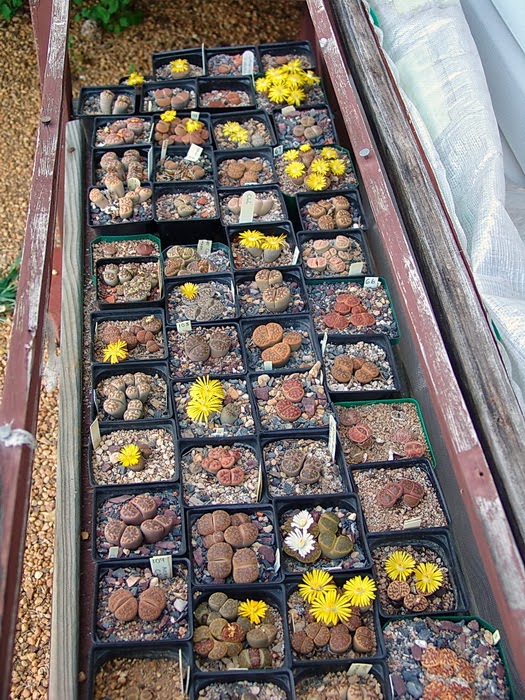
I grow my lithops outside during the frost free part of the year.  They receive approximately 6 to 8 hours of direct sun daily.  To manage the amount of water they receive, I place them on a small platform (shown) that is covered with clear plastic.
The plastic only covers the top and back of the frame, thus allowing good air circulation.  

The cover is easily removed when I want to examine or water the plants.   Space is limited to 60 to 80 pots depending on the size of the pots.  The surface area of the platform equals the space I have inside the house where the lithops will spend the winter. On average I move the plants outside in late April and back inside in late October.


The photo to the right was taken today, October 2, 2013.  I've moved the plastic cover back off the platform to show the plants in flower. Almost all the plants shown were grown from seed.   I have done a little pollinating but I'm not sure why; maybe just to enjoy watching the seed capsules develop.  I really don't have room for a lot more plants.  I sold, or gave away, 18 adult lithops this summer at our (Washington, D.C. C&S Society) local society show and sale.  While my C&S collection is a general mix of many types of cacti and other succulents, I have more lithops than any other genera, although the numbers of  astrophytum cacti in the collection is growing rapidly.  :)

Lithops are neat plants and I really enjoy growing them. 


Sunday, September 29, 2013

Lithops Flowering Season

Lithops  bromfieldii  var.  insularis 

Lithops, commonly known as "Living Stones," are succulent plants from South Africa and Namibia.  While they are primarily grown for their interesting form and color, (they indeed  look like small, colorful stones), they also produce attractive flowers.  Lithops are "short day" plants.  They produce their flowers in the late summer through late fall, as the hours of daylight grow shorter and shorter.  As September comes to a close it's the species Lithops bromfieldii, and its varieties, that are in the midst of their flowering period.
 
 
The plant shown above is actually two 4-headed plants I potted together to fill a 4 inch square (10 x 10 cm) pot and provide a more attractive display.  I grew the two 4-headed plants from seed sown in 2004.   My lithops spend the summer outside in full sun, but under a cover of clear plastic to control the amount of water they receive.  In the winter they all come inside the house to a sunny, south facing windowsill.  I've been growing lithops for quite a few years, but it is always a great thrill to watch them produce their bright, cheerful flowers in the fall.     


Saturday, September 21, 2013

Seedling Variation


Seedling Variation in Titanopsis calcarea

 
One of the exciting, and yet sometimes frustrating, things about growing succulents from seed is you never really know what you are going to get.  This is especially true when the pollination is "open," meaning you don't control the origin of the pollen. You know the identify of the female plant, because that is the plant from which you collect the fruit and hence the seed.   However, often you don't know the plant which supplied the pollen that pollinated that female plant.  That was the situation for seed I harvested, and sowed, from a Titanopsis calcarea plant in the autumn of 2011.  The result was approximately 12 seedlings which were moved outside to one of my over wintering frames in the summer of 2012, and basically forgotten.   This spring, I began cleaning out this over wintering frame and rediscovered the seedlings.  Most were typical Titanopsis calcarea, they looked just like the female parent,  but three were different.  They were definitely T. calcarea, but they looked different.  They displayed the variation that often occurs when you grow from seed. 

 
Seedling #1 (above) is Titanopsis calcarea but compared to the parent plant, the tips of the leaves are more pronounced and the warts (the round markings on the leaf tips) are larger and lighter in color.  For me, it's more attractive than the parent T. calcarea.
 
 
Seedling #2 also has the tips of the leaves more pronounced, but the warts are not as numerous as on seedling #1 and not as white.  It too is quite different in appearance in comparison with the parent plant. 
 
 
Seedling #3 is perhaps the most interesting.  Again, the leaf tips are more pronounced, and the warts large and white, but now there is a noticeable red coloration surrounding the warts.  The white warts, surrounded by red, on the ends of gray-green leaves produces a very different and attractive looking plant. 
 
All three seedlings are still Titanopsis calcarea, but they are all slightly different from each other and different from their parent from which the seed came.   That's the fun of growing from seed.  Such noticeable variation doesn't always occur, but it occurs often enough to keep one's eyes watching those emerging seedlings very closely with the excitement of removing the wrapping of a new gift.  As those seedlings grow you just never know what you are going to discover.   


Thursday, September 12, 2013

Big Smelly Succulent Flowers

Stapelia  gigantea


If you like LARGE flowers, you will love the flowers of Stapelia gigantea.  If you like FRAGRANT flowers, you will NOT like Stapelia gigantea.  Here we have a succulent plant with large  flowers, that resemble, and smell like, the decaying carcass of a dead animal.  Why?

    
The answer lies in the type of insect that pollinates Stapelia gigantea.  Perhaps you have already guessed, the pollinators are flies.  Indeed, if you have a flowering Stapelia gigantea, you will find a constant stream of flies coming to the flowers, and the flowers themselves inhabited by fly maggots. 

If you have space, a lot of sun, and warm temperatures, Stapelia gigantea is easy to grow.  Provide plenty of water during the spring and summer growing period, and keep drier and warm over the winter.  If you have Stapelia gigantea and it has never flowered for you, you are probably not providing enough sun.

Stapelia gigantea is native to large areas of south-central and south-eastern Africa.