Saturday, December 14, 2013

Haworthias


Haworthia mirabilis var. badia

 Along with lithops, haworthias are one of my favorite succulent plants.  They are relatively small, easy to grow, and come in a variety of forms, textures, and colors.  Haworthias don't require the high light intensity many succulents need, however, I like the stronger colors that develop under lots of sun.  Such is the case with Haworthia mirabilis var. badia
 
 
This particular plant was a gift from a friend that specializes in haworthias.  The variety name "badia" means reddish-brown.


Wednesday, December 4, 2013

Cacti and Succulents in the Winter Window

Astrophytum Hybrid Collection

For the past four years I have been growing seedlings from astrophytum hybrid seed.  I have selected some of the more attractive types, with the hope of cross pollinating them to produce even nicer plants.  I didn't want to trust them spending the winter outside in the heated frames,  http://stewart723.blogspot.com/2013/11/succulent-winter-quarters.html  where I over-winter most of my plants.  Instead, I am over-wintering them inside the house on a shelf near a south facing window.  Many of these should flower next year and I will cross pollinate them and sow the resulting seed. 


Haworthia truncata Collection

I grow quite a few haworthias, but my favorites are H. truncata.  I have recently been growing them from seed I obtain from my older plants.   I didn't want to risk these in the outdoor heated frames, so they are also in the house on the shelf in the south facing window.  Although they don't get as much light as they would outside, at least they are available for me to work with over the winter.  The haworthias will often produce flowers in late winter and I'll cross pollinate some of the plants and hopefully get fruit and seeds.   


Sunday, November 17, 2013

Winter Flowers A-Coming

Aloinopsis  malherbei

 
My Aloinopsis malherbei, is now comfortably in one of my over-wintering, outdoor cold frames where it enjoys plenty of sun and cool, crisp night temperatures.  As you can see, it has shown its satisfaction by budding up.  While I primarily grow A. malherbei for its wonderful leaf form, which includes the leaf shape and the small white tubercles that adorn the back and tip margins, the flowers are always welcome.   If I remember correctly, this plant was grown from seed planted in the winter of 2002, making it almost 14 years old.  It's never given me any problems and is now an old friend. 

**Obviously my math isn't very good -  above line should read, "making it almost 12 years old".     


Saturday, November 16, 2013

Succulent Winter Quarters

Over-wintering My Cacti and Other Succulents

I over winter the bulk of my cacti and other succulent collection in two 5 x 8 ft. (1.5 x 2.5 meter) wooden boxes (shown below) that are covered with 6 mil plastic  and heated with a 1200 watt electric heater.  This over wintering method provides two desireable features. First, much like a greenhouse, it provides excellent winter light for the plants.  Second, it allows a relatively low night temperature, usually around 42 degrees F. (5.5 degrees C).  I've found that many succulents flower better when given a cool night temperature over the winter.  Basically, this is a low cost alternative to a greenhouse.  

The frames are covered initially with a single layer of 6 mil clear plastic.  When night temperatures begin to drop below 20 degrees F. (-6.5 degrees C), a second layer of plastic is added.  The plastic is draped completely over the frames and held in place with six cinder blocks per frame.   

The frames have proven successful in tempertures as low as 5 degrees below zero F. (-21 degrees C), and in snowfall depths of 25 inches (63 cm).  There are two major problems with this system of over-wintering.  First, a loss of electricity can drop the temperature in the frames to a plant damaging level within 4 hours.  To handle such an emergency I have two backup generators that can be used to keep the frames heated until the power is restored.  The second major problems is very limited access to the plants over the winter.  I do not remove the plastic unless the outside temperature is above 45 degrees F. (7.2 degrees C).  Occasionally two weeks can pass without being able to open the frames.      

I have been using these over-wintering frames for the past 12 years and they have performed well.  They cost less than $300 dollars to build (the biggest expense is thermostats for the heaters) and the monthly electricity cost average about $40 for both frames.

Friday, October 18, 2013

It's Lithops Blooming Time !!

Lithops  lesliei  var.  hornii 


I have more plants of Lithops lesliei than any other type.  I like the large size of the plants, the relatively flat top of the leaves, the very interesting patterns of the leaf colors, and last but not least,  they are one of the easiest lithops to grow. 
 
Shown is a three headed plant of L. lesliei v. hornii C364.  It was grown from seed planted in the fall of  2002.  Lithops are occasionally called "Midday Flowers" because the flowers usually don't open wide until about 3:00 p.m. in the afternoon. 


Monday, October 14, 2013

Growing the Weirdest of the Weird

Astrophytum caput-medusae


As plants go, cacti are weird.  They are usually round or cylindrical and either covered with spines, hair, wool, or some strange textured material.  Since I like weird plants, I collect and grow cacti, and one of my favorites are the species and varieties of the genus Astrophytum, the star cactus.  The astrophytums are round or slightly columnar, and their bodies covered with small tufts of white hairs or scales called trichomes.  Their flowers are relatively large, usually yellow, often with red centers.  As plants go, like the other cacti, astrophytums are weird.   Shown at the right is Astrophytum myriostigma. 
 
On August 28, 2001 in Nuevo Leon, Mexico, Manuel Nevárez discovered a very strange, and weird cactus, one that had never been seen before.  Finding a plant, in this case a cactus, new to science is a great discovery. But this cactus was not only new, it was really weird.  It wasn't round or cylindrical, instead, it had tentacles (botanically known as tubercles).  The tubercles were covered with white wool or scales, just like astrophytums.  When it flowered, the flowers were relatively large, yellow, with red centers, just like astrophytums.  The fruit and seeds were also just like those of other astrophytums.  Although there are disagreements, most botanist now believe this is another species of astrophytum, perhaps the weirdest of the weird.
 
The photo of the new Astrophytum caput-medusae
at right is from the book "Ariocarpus et cetera" by John Pilbeam & Bill Weightman. which has a wonderful section on astrophytums.  I didn't have my own photo of A. caput-medusa because I had never grown one.
 
Since I like growing astrophytums, and this was certainly an interesting one, I finally ordered 10 seeds.  I sowed the seeds in March 2013.  Eight seeds germinated but two of the tiny seedlings died during the first few weeks, but six survived and are now beginning to developed into that weird form complete with long, tentacles covered with the white trichomes.  The growth is very slow, likely because these plants have a large, tuberous root,  which develops before the top growth gets large.  Right now my Astrophytum caput-medusa seedlings (shown at right) are growing under fluorescent lights and will remain there until next summer when I will introduce them to the sun.
 
I always enjoy growing new and unusual plants, although it is always a little scary when you have no experience with them.  I look forward to watching them grow and mature, and hopefully produce their beautiful flowers.  I'll try to keep their progress posted right here on Cactus Hill Adventures.   If anyone out there is growing, or has grown this strange plants please tell us about it.  Thanks.   


Wednesday, October 2, 2013

Summer Lithops Home

 
The Summer Home for my Lithops

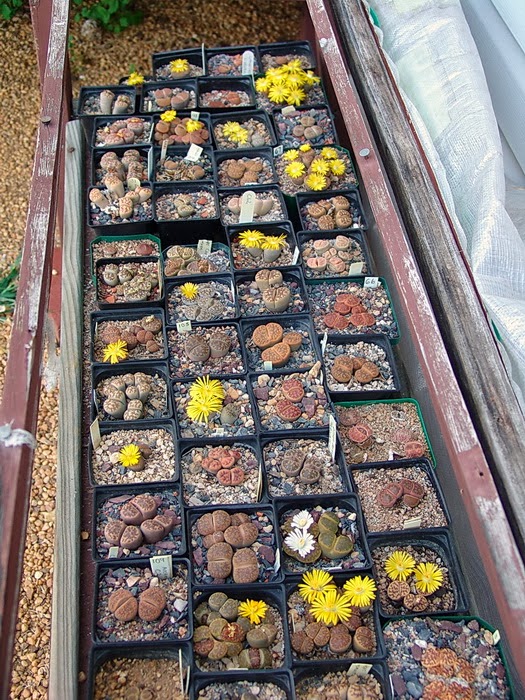
I grow my lithops outside during the frost free part of the year.  They receive approximately 6 to 8 hours of direct sun daily.  To manage the amount of water they receive, I place them on a small platform (shown) that is covered with clear plastic.
The plastic only covers the top and back of the frame, thus allowing good air circulation.  

The cover is easily removed when I want to examine or water the plants.   Space is limited to 60 to 80 pots depending on the size of the pots.  The surface area of the platform equals the space I have inside the house where the lithops will spend the winter. On average I move the plants outside in late April and back inside in late October.


The photo to the right was taken today, October 2, 2013.  I've moved the plastic cover back off the platform to show the plants in flower. Almost all the plants shown were grown from seed.   I have done a little pollinating but I'm not sure why; maybe just to enjoy watching the seed capsules develop.  I really don't have room for a lot more plants.  I sold, or gave away, 18 adult lithops this summer at our (Washington, D.C. C&S Society) local society show and sale.  While my C&S collection is a general mix of many types of cacti and other succulents, I have more lithops than any other genera, although the numbers of  astrophytum cacti in the collection is growing rapidly.  :)

Lithops are neat plants and I really enjoy growing them.